

Selective Shoppers, Tighter Margins: Why Connected Retail Operations Matter More Than Ever

Canadian retailers are operating in a market where customers remain willing to spend, but are paying closer attention to value.
The Retail Council of Canada described value as a dominant consumer mindset entering 2026, with spending tilted toward essentials and retailers keeping margin protection in focus. Its Spring 2026 retail conditions report also found signs of resilience: 63% of the retailers surveyed reported positive year-over-year growth, despite weather-related challenges for seasonal businesses.
The picture is therefore not simply one of declining demand. It is a more complicated environment in which retailers must respond to cautious shoppers, changing demand and ongoing economic uncertainty without relying too heavily on broad discounts.
The Bank of Canada’s first-quarter 2026 Survey of Consumer Expectations found that concerns about high prices and economic uncertainty continued to weigh on household spending plans, even though consumer sentiment had improved from the previous quarter.
For retailers, this makes operational visibility increasingly important. When customers are more selective, businesses need to understand what is selling, where inventory is available and which activities are contributing to performance.
That is where connected retail operations can make a meaningful difference.
What connected retail operations mean
Connected retail operations bring information and processes from different parts of the business into a coordinated environment.
Depending on the retailer, this can include:
- Point-of-sale activity
- Inventory and merchandise management
- Store operations
- E-commerce
- Order fulfillment
- Customer information
- Loyalty programs
- Reporting and business intelligence
- Head-office management
The objective is not simply to add more technology. It is to give stores, e-commerce teams and management access to consistent information so they can coordinate decisions across the retail organization.
ACCEO Retail-1 is designed as a single retail management system that integrates in-store, e-commerce and head-office operations. Its omnichannel capabilities include real-time visibility across the retail ecosystem, flexible fulfillment, business intelligence, CRM and loyalty functionality, endless-aisle capabilities and web integration options.
Why disconnected information creates challenges
Retail businesses often expand their technology over time. A point-of-sale system may be introduced first, followed by an e-commerce platform, reporting tools, loyalty applications and other specialized systems.
Each application may serve a purpose. The difficulty arises when information does not move easily between them.
For example, a retailer may have inventory information in one system, online orders in another and store performance reports somewhere else. Employees may then need to compare reports or transfer information manually before they can see what is happening across the business.
This can make it more difficult to answer practical questions such as:
- Is an item available at another store or distribution location?
- Can an online order be fulfilled using inventory from a physical location?
- Which products are performing well across the entire retail chain?
- Are stores and online channels using consistent customer and merchandise information?
- Which customers and products are contributing the most value?
- Where should management investigate unusual performance?
A connected platform does not remove the need for retail judgment. It can, however, give decision-makers a more complete and timely view of the information behind those decisions.
1. Improve inventory visibility across channels
Inventory is one of a retailer’s most important resources. It also becomes more difficult to manage as the number of stores, warehouses, selling channels and fulfillment options increases.
Retailers need to know not only how much inventory they own, but where it is located and how it is moving.
ACCEO Retail-1’s e-commerce integration provides a global view of inventory, orders and customer data across online and physical operations. Its omnichannel offering is also designed to provide real-time visibility across the retail ecosystem.
This kind of visibility can help teams coordinate activities such as:
- Reviewing stock across locations
- Managing online and in-store inventory
- Identifying available merchandise for customer orders
- Supporting cross-channel fulfillment
- Maintaining more consistent stock information
- Investigating merchandise performance
The value of inventory visibility is not simply that more data becomes available. It is that teams can use a shared view of inventory when serving customers and planning operations.
2. Make fulfillment more flexible
Customers may discover a product online, visit a store to examine it and choose a fulfillment method based on convenience.
Supporting that journey requires coordination between selling channels and inventory locations.
A retailer may need to determine whether an order should be shipped, prepared for pickup or fulfilled from another location. The appropriate option will depend on the retailer’s inventory, operating model and available fulfillment capabilities.
ACCEO Retail-1’s omnichannel offering includes flexible fulfillment functionality intended to help retailers coordinate customer demand across channels.
When order and inventory information are connected, employees can work from a clearer understanding of what is available and what fulfillment choices the business can support. This helps the retailer create a more consistent experience without treating each channel as a completely separate operation.
3. Use customer information more purposefully
In a value-conscious market, the answer is not always to offer the same discount to every shopper.
Different customers have different purchase histories, preferences and levels of engagement. Retailers that can access and understand their customer data are better positioned to plan relevant communications and loyalty activities.
ACCEO Retail-1’s omnichannel offering includes CRM and loyalty capabilities, while its business intelligence tools provide access to customer information alongside inventory, merchandise and store operations data.
This can help retailers examine questions such as:
- Which customers purchase most frequently?
- Which merchandise is associated with valuable customer segments?
- Which customers have become less active?
- Which offers are appropriate for a particular audience?
- How are loyalty activities connected to purchasing behaviour?
Customer data should be used in accordance with applicable privacy requirements and the retailer’s own data-governance practices. Within those boundaries, connected customer and transaction information can support more informed marketing decisions than a one-size-fits-all approach.
4. Bring operational data into everyday decisions
Retail reporting is most useful when it helps teams decide what to do next.
ACCEO Retail-1’s business intelligence capabilities include dashboards with key performance indicator summaries for stores, suppliers and merchandise. Its Simon mobile intelligence application provides real-time access to inventory, merchandising, store operations and customer data.
These capabilities can give authorized users a consolidated view of retail activity without requiring them to evaluate each operating area in isolation.
Depending on the retailer’s implementation and data practices, management may use business intelligence to:
- Review store and merchandise performance
- Compare results across locations or periods
- Examine supplier-related information
- Identify products or areas that require attention
- Monitor inventory and operational indicators
- Access key information away from a fixed workstation
Data does not make decisions on its own. Its role is to help retail leaders identify patterns, ask better questions and respond with greater context.
5. Protect margins through better-informed execution
Margin protection does not depend on a single report or software feature.
It involves many operational decisions, including merchandise planning, inventory allocation, pricing, promotions, fulfillment and store execution.
The Retail Council of Canada’s research indicates that value remains important to Canadian consumers and that margin defence continues to be a priority for retailers. In this environment, businesses need to balance customer expectations with commercial discipline.
Connected information can support that balance by helping retailers understand performance before making decisions.
For example, rather than treating every slow-selling product in the same way, teams can review inventory levels, merchandise performance, location-level results and other available information. Instead of evaluating a promotion solely on sales volume, retailers can consider the relevant performance data available within their systems.
The platform cannot guarantee higher margins, and results will depend on factors such as implementation, data quality, retail strategy and staff execution. What connected operations can provide is a stronger information foundation for making and evaluating those decisions.
Is your retail operation truly connected?
Retailers can begin by asking a few practical questions:
- Can we see inventory across our relevant stores, warehouses and online operations?
- Can our teams coordinate online and in-store orders using consistent information?
- Are customer, product and transaction records accessible to the people who need them?
- Can management review store and merchandise performance without manually combining multiple reports?
- Do our business intelligence tools provide information quickly enough to support operational decisions?
- Can our systems support the fulfillment options we offer customers?
- Are our stores, e-commerce operations and head office working from a shared view of the business?
A “no” or “not consistently” does not necessarily mean every system must be replaced immediately. It does indicate an area where disconnected processes may be limiting visibility or creating additional work.
Build a more connected retail organization
Selective shoppers and economic uncertainty make it increasingly important for retailers to operate with accurate, accessible information.
Connecting stores, e-commerce, inventory, customer information and head-office operations gives teams a clearer view of the business. It can also help retailers coordinate fulfillment, evaluate merchandise performance and respond more effectively as customer needs change.
ACCEO Retail-1 brings in-store, e-commerce and head-office operations together within a single retail management system, with capabilities for omnichannel retailing, inventory visibility, customer management and business intelligence.
See how ACCEO Retail-1 can help connect your retail operations and give your teams the information they need to make better-informed decisions.
Related posts
Discover what makes us different.
Book your personalized demo today and find out why leading retailers are finding success with Retail-1.
Call us at 1 888-353-5888 or fill out the form to schedule a demo with our experts.
AEO vs. SEO: Preparing Retailers for the Next Evolution in Digital Visibility
In the retail sector, visibility has always been the foundation of growth. Historically, Search Engine Optimization (SEO) has been the primary strategy to ensure that customers find businesses online. However, as consumer behavior evolves and artificial intelligence (AI) technologies reshape the way information is delivered, a new concept is emerging: Answer Engine Optimization (AEO).
Retailers who understand the distinction between SEO and AEO—and how to leverage both—will be better positioned to meet modern consumer expectations and secure a competitive advantage.
Understanding SEO
Search Engine Optimization (SEO) is the discipline of improving a website’s visibility on traditional search engines such as Google and Bing. The goal is to rank higher on search engine results pages (SERPs) and attract traffic through:
- Keyword-driven product descriptions and category pages.
- Technical improvements such as mobile responsiveness and site speed.
- Building domain authority through backlinks.
- Publishing high-quality, intent-focused content.
SEO remains a critical practice, as it influences how potential customers discover a retailer’s website when browsing online.
What is AEO?
Answer Engine Optimization (AEO) expands on SEO by preparing content for AI-powered answer engines. Unlike search engines that present multiple links, answer engines are designed to provide direct, conversational responses. Examples include:
- Voice assistants such as Alexa, Siri, and Google Assistant.
- AI-driven platforms such as ChatGPT or Bing AI.
- Intelligent digital assistants within retail applications.
In practical terms, AEO ensures that when a customer asks, “Where can I find same-day pickup for school supplies near me?”, your business is positioned as the precise and trusted answer.
Why AEO is Crucial for Retailers
Consumer behavior is shifting from browsing to asking. This transformation has several implications for retailers:
- Voice-driven commerce growth: Natural, conversational queries are increasing through voice-enabled devices.
- Demand for precision: Shoppers expect accurate, immediate answers rather than lists of potential sources.
- Local intent dominance: Many queries relate to store hours, stock availability, and proximity.
- AI adoption: As consumers adopt generative AI tools, being discoverable within these environments becomes essential.
Retailers who embrace AEO now will not only improve customer acquisition but also enhance customer trust and brand authority.
Strategies for Leveraging AEO in Retail
To adapt successfully, retailers should consider the following approaches:
- Adopt natural language in content: Reflect conversational patterns in FAQs, product details, and customer support pages.
- Implement structured data (schema markup): This enables AI systems to interpret product, location, and availability data with precision.
- Prioritize local optimization: Ensure business listings are accurate and continually updated, particularly regarding operating hours and stock information.
- Develop robust FAQs and knowledge hubs: Anticipate customer questions and provide concise, authoritative answers.
- Integrate AI-driven retail solutions: Leverage platforms that support omnichannel engagement and are optimized for AI interaction.
Looking Ahead: AEO as a Strategic Imperative
SEO will continue to play a vital role in attracting customers through traditional search engines. However, AEO is rapidly becoming a strategic necessity as consumers turn to AI-powered tools for immediate, reliable answers. By aligning with both SEO and AEO practices, retailers can secure their presence across all digital touchpoints.
Forward-looking organizations are already adopting technology partners who specialize in retail transformation. Companies such as ACCEO Retail Solutions are equipping retailers with the digital infrastructure needed to stay competitive in this evolving landscape—ensuring that when customers ask, the right answer is always within reach.
Discover what makes us different.
Book your personalized demo today and find out why leading retailers are finding success with Retail-1.
Call us at 1 888-353-5888 or fill out the form to schedule a demo with our experts.
How to Use the Retail Technology Maturity Model to Map Your Growth
Introduction
In today’s retail environment, technology is more than a back-office tool – it’s the foundation for growth, customer loyalty, and competitiveness. The challenge is knowing exactly where your business stands today and what steps will take you further.
The Retail Technology Maturity Model Canada is designed to make that journey clear. It gives retailers and their VAR partners a practical way to assess current capabilities, identify challenges, and pinpoint the technologies that will unlock the next stage of success.
Whether you’re planning your own upgrades or helping clients do the same, this model takes the guesswork out of the process.
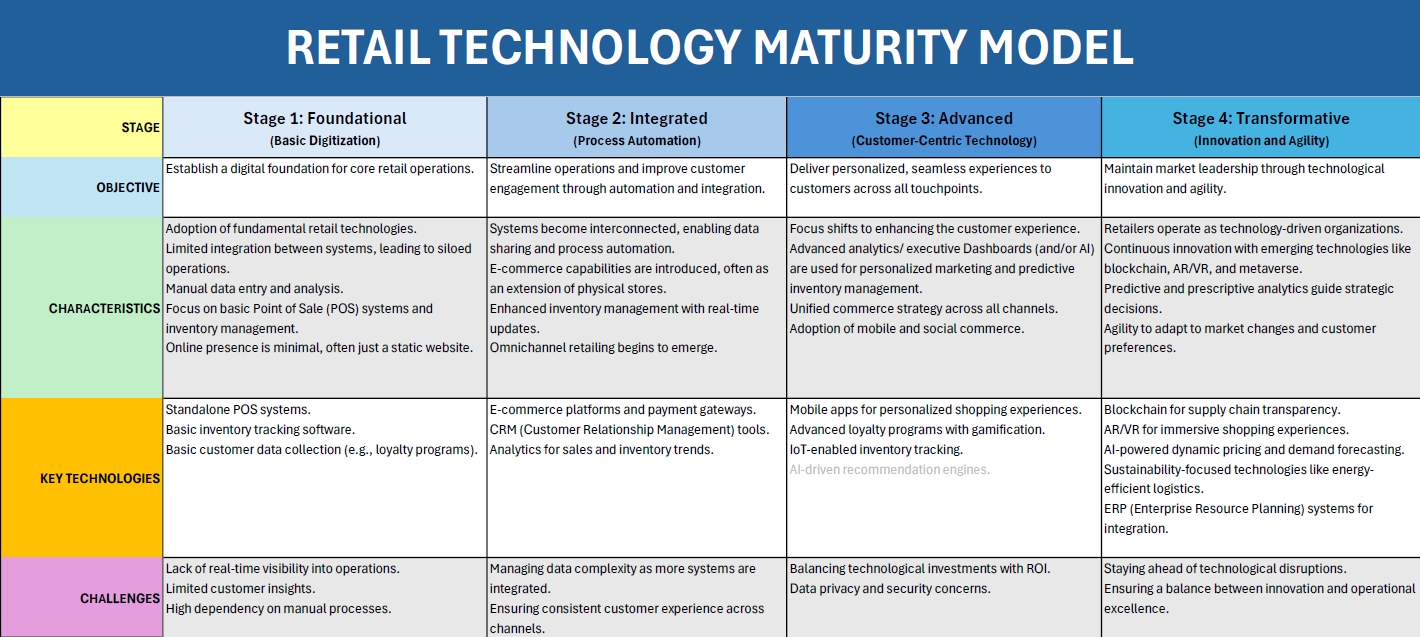
Stage 1: Foundational (Basic Digitization)
Objective: Establish a digital foundation for core retail operations.
Typical setup:
Standalone POS systems: Limited functionality, but a step up from paper invoices or mechanical cash registers.
Basic inventory tracking: Labour-intensive, non–real-time tools, useful mainly for periodic counts.
Minimal reporting: A few basic metrics, such as daily or monthly sales summaries.
Common pain points:
- Manual sales tracking
- No real-time inventory visibility
- Limited customer data
Typical retailer: Often smaller-volume businesses or new entrepreneurs, cautious about over-investing early on. Customer relationships are personal and transaction-based, with no centralized data to guide decisions.
Next step: Connect core systems to reduce manual work and eliminate data silos.
Stage 2: Integrated (Process Automation)
Objective: Streamline operations and improve customer engagement through connected systems.
Typical setup:
- POS integrated with e-commerce and payment gateways: Unified online and in-store sales tracking, plus integrated payment data.
Analytics and advanced reporting: Data-driven insights into sales trends, inventory performance, and purchasing behaviour, enabling proactive decision-making.
Multi-location inventory management: Real-time tracking across stores or channels, including online.
Common pain points:
- Disconnected online/offline channels
- Manual data entry and reconciliation
- Inventory mismatches
Typical retailer: Small to mid-sized businesses such as boutiques, sporting goods stores, or garden centres. Often operating both a physical location and an e-commerce site (e.g., Shopify).
Next step: Use integrated data to enable personalized marketing and more precise inventory control.
Stage 3: Advanced (Customer-Centric Technology)
Objective: Deliver personalized, seamless experiences that build loyalty and increase lifetime customer value.
Typical setup:
Customer profiles: Purchase history and preferences stored for targeted offers, loyalty programs, and enhanced customer experiences.
Mobile apps for personalized shopping: Custom recommendations, targeted promotions, loyalty rewards, and real-time, location-based offers.
Targeted promotions and loyalty programs: Campaigns triggered by customer behaviour, often delivering measurable revenue lifts.
Common pain points:
- Limited insight for targeted engagement
- Difficulty personalizing across multiple channels
- Balancing technology investment with returns
Typical retailer: Well-established small and medium businesses optimizing efficiency and customer engagement. For many, this is the highest functionality currently offered by mainstream POS providers.
Next step: Introduce predictive analytics and AI to anticipate customer needs and refine operations.
Stage 4: Transformative (Innovation and Agility)
Objective: Maintain market leadership through innovation and rapid adaptation.
Typical setup:
AI-powered sales forecasting: Predict demand and automate inventory reordering to reduce waste and avoid stockouts.
Blockchain for supply chain transparency: Create a tamper-proof record of a product’s journey, increasing trust, authenticity, and recall efficiency.
AR/VR for immersive shopping: Let customers visualize products in their own space, try on items virtually, or explore digital showrooms.
ERP (Enterprise Resource Planning): Integrate finance, inventory, sales, HR, and purchasing into one platform for real-time visibility and streamlined operations.
Common pain points:
- Keeping pace with market shifts
Staying ahead of emerging technologies
Scaling innovations efficiently
Typical retailer: Large enterprises already use these technologies, but they’re becoming accessible for small and medium businesses. The efficiencies gained, from reduced costs to higher margins, can be game-changing.
How to Use the Model
Retailers: Use this as a self-assessment tool. Identify your current stage, review the challenges, and plan the technology investments that will move you forward.
VARs: Use the model as a framework in discovery conversations to guide clients toward their next milestone.
No matter where you are today, there’s a clear path to greater efficiency, stronger customer relationships, and higher profitability. The Retail Technology Maturity Model is your roadmap, and we’re here to help you navigate it.
Explore the next step in your journey and contact our sales team for a free consultation.
Frequently Asked Questions
Even with a clear roadmap like the Retail Technology Maturity Model, you might still wonder how to apply it to your business. Here are answers to some of the most common questions we hear from small and medium-sized retailers, and from VARs who work with them.
How do I know which stage my business is in?
Look at your current systems and processes. If you’re still relying on standalone POS systems and manual reports, you’re in Stage 1. If your systems talk to each other and you use data to guide decisions, you’re in Stage 2 or beyond.
Do I need to move through every stage in order?
Not necessarily. Some retailers leapfrog stages when they make a major investment in technology. However, skipping essential foundations, like integrating systems before adding advanced customer tools, can create inefficiencies later.
What’s the fastest way to see a return on new technology?
Focus on upgrades that reduce manual work, improve accuracy, and boost customer satisfaction. For many SMBs, moving from Stage 1 to Stage 2 through system integration delivers quick wins in efficiency and sales.
Is Stage 4 realistic for a small or medium business?
Yes. While these technologies were once reserved for large enterprises, they’re becoming more affordable and accessible. AI forecasting, blockchain tracking, and AR/VR experiences are already appearing in SMB-friendly retail software.
How can my VAR help me move to the next stage?
Your VAR can assess your current stage, recommend solutions tailored to your needs, and manage the implementation. They can also train your team to make the most of new tools, ensuring you see measurable results faster.
Related posts




Discover what makes us different.
Book your personalized demo today and find out why leading retailers are finding success with Retail-1.
Call us at 1 888-353-5888 or fill out the form to schedule a demo with our experts.
7 Order Management Superpowers Every Retailer Needs (And How to Get Them)

In today’s fast-paced, omnichannel retail environment, managing orders across multiple platforms can feel overwhelming. That’s where an Order Management System (OMS) steps in — giving retailers powerful capabilities to handle complexity with confidence. Below are seven essential “superpowers” an OMS can deliver, and how ACCEO Retail-1’s solution brings them to life.
-
Centralized Order Visibility
Retailers need a single, reliable view of every order, no matter where it was placed. A good OMS consolidates all order data from stores, websites, and marketplaces into one intuitive dashboard. This means your team can quickly answer customer inquiries, track shipments, and spot issues in real time. ACCEO Retail-1’s OMS provides this unified visibility — complete with detailed order status, item photos, and tracking information — enabling faster, more accurate responses.
-
Inventory Optimization
Avoiding stockouts and overstocks is critical for profitability. An OMS helps by offering real-time inventory visibility across all stores and warehouses. When an order is placed, stock levels update instantly, preventing overselling and enabling smarter replenishment. ACCEO Retail-1’s OMS empowers retailers to maintain optimal inventory levels by syncing data across channels and helping allocate stock where it’s needed most.
-
Seamless Multi-Channel Fulfillment
Today’s shoppers expect flexibility — whether it’s buying online and picking up in-store or getting items shipped from the nearest location. A capable OMS routes orders intelligently based on location, stock availability, and shipping speed. ACCEO Retail-1’s system supports omnichannel fulfillment scenarios like BOPIS and ship-from-store, making it easy to fulfill orders from the most efficient source while minimizing delays and costs.
-
In-Store Order Management
Don’t let limited shelf space cost you a sale. With the right OMS, store associates can create orders for out-of-stock items and have them shipped directly to customers — turning every store into an “endless aisle.” ACCEO Retail-1’s OMS allows in-store staff to access chain-wide inventory, place custom orders, and manage fulfillment, boosting customer satisfaction and saving otherwise lost sales.
-
Real-Time Reporting & Analytics
Instant access to order data is vital for making informed decisions. Whether it’s understanding sales trends or spotting fulfillment delays, an OMS with strong reporting capabilities puts insights at your fingertips. ACCEO Retail-1’s OMS offers an easy-to-use dashboard and exportable data tools, so managers can monitor performance and act quickly without needing to wait for IT reports.
-
Exception Handling
Even the best-run operations face unexpected issues — delayed shipments, out-of-stock items, or payment problems. A modern OMS flags these exceptions so they can be resolved proactively. ACCEO Retail-1’s OMS lets users filter and locate problem orders quickly, with full visibility into their status, helping teams step in and fix issues before they escalate.
-
Operational Efficiency & Cost Savings
Manual processes are slow and error-prone. A strong OMS automates routine tasks like inventory updates, order confirmations, and shipping decisions. ACCEO Retail-1’s solution is built to streamline workflows and reduce human error, enabling retailers to handle more orders with less effort. From barcode scanning to fulfillment optimization, it’s designed to drive efficiency and improve margins.
Final Thoughts
Each of these OMS “superpowers” solves real-world retail problems — from increasing sales and customer satisfaction to reducing costs and operational headaches. ACCEO Retail-1’s OMS is purpose-built to help retailers gain these advantages with a powerful, on-premises solution that’s reliable, flexible, and tailored for the realities of modern retail.
Want to unlock these order management superpowers? Learn more at the ACCEO Retail-1 Order Management System page.
Related posts






Discover what makes us different.
Book your personalized demo today and find out why leading retailers are finding success with Retail-1.
Call us at 1 888-353-5888 or fill out the form to schedule a demo with our experts.